
In modern retail, two types of analytical systems are increasingly used: counting the flow of visitors, and a facial recognition system that analyzes demographic characteristics - age and gender. Although these systems can be installed in the same place, their data cannot be directly compared. The reason is simple: these are two different technologies that solve two different problems.
It is important to note that the visitor count is a quantitative indicator (how many people passed), while face recognition operates as a percentage - that is, the proportion of people the system was able to correctly identify.
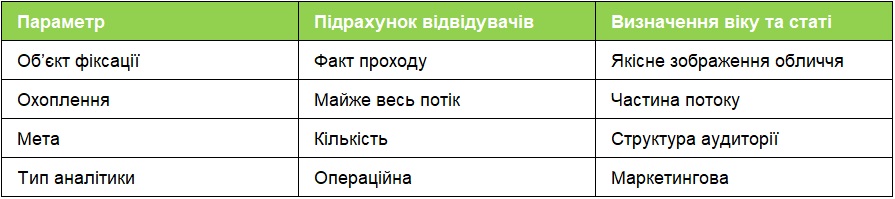
The main task is to fix the fact of the passage of manthrough a certain area.
• Fixes every intersection of the input/output line
• Does not require facial recognition
• Works no matter what the person looks like
• Provides high accuracy (usually 95— 98%)
It is a tool to measure traffic: how many people came in, left, at what time there was a peak in attendance, etc.
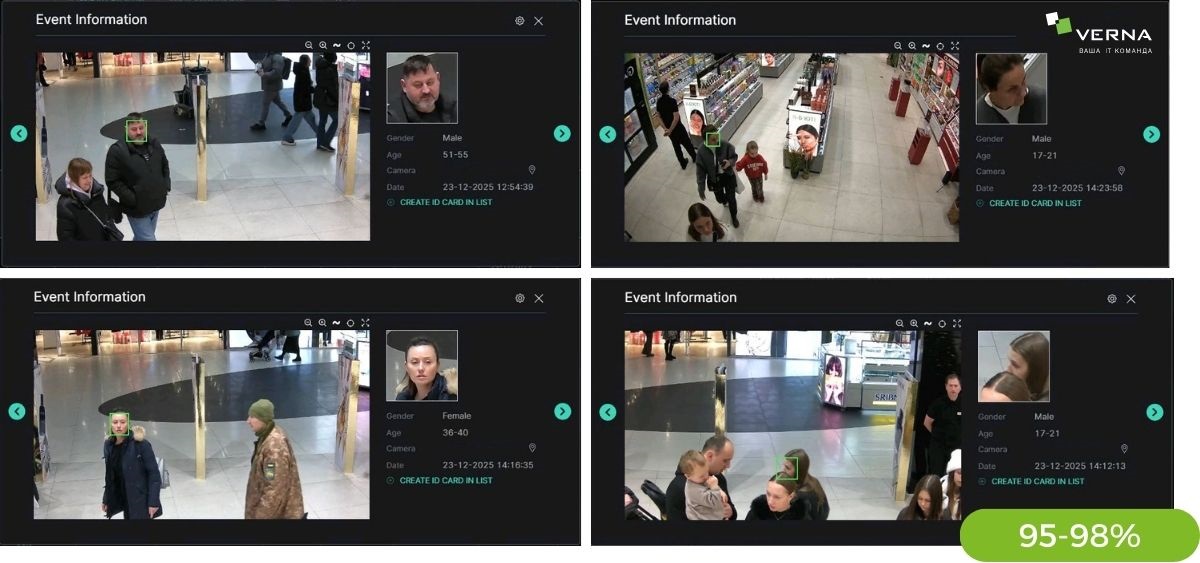
The main task — analyze demographic characteristics, but only if the system was able to recognize faces qualitatively.
• Only works when the camera confidently finds the face
• Requires sufficient image quality
• Has limitations in real conditions
• Gives an estimate of age (e.g., with an accuracy of ±5 years in 67% of cases for people around 35 years old — i.e. within 30—40 years)

It is a tool for marketing analytics, not for accurately counting each person.
In real conditions, it is impossible to get 100% recognizable faces from 100% of visitors. And this is technically normal.
• Man looks down at phone
• Face turned sideways
• Face partially closed (hat, hood, scarf, hair)
• A person passes quickly
• Insufficient or uneven lighting

The counting system will record each pass.
The demographic analysis system is only those cases where the face was of sufficient quality for analysis.
In fact, the “rejection” mechanism works: part of the stream does not automatically fall into demographic statistics.

Reputable sources such as McKinsey & Company, NielsIQ, and Harvard Business Review confirm: customer analytics is used as Decision-making tooland not as a way to count each person perfectly.
Demographic data makes sense in comparison.
September:
November:
The result is an increase of 75% in the target group.
This gives grounds for optimizing advertising campaigns, changing the design and presentation of content, correcting the assortment, assessing the effectiveness of marketing activities.
That is important dynamics and ratiosNot an absolute number.
Comparing the total number of visitors to the number of recognized faces is like comparing:
• total traffic to the site
• with the number of users who filled out the form with personal data
These are different levels of analytics.
The counting system answers the questions:
“How many people came?”
The system for determining age and sex answers the questions:
“Who are these people by demographic characteristics among those who were able to qualitatively analyze?”
• work according to different algorithms
• have various technical limitations
• Solve various business problems
• generate different types of data
Therefore, their performance cannot be directly compared or expected to be the same.
The correct approach is to use each system for its intended purpose: counting — for measuring traffic, demographic analytics — for strategic marketing decisions and comparing the dynamics of indicators over time.
VERNA - 2026
Contact us to learn more about our solutions and projects


